
Brothers: Write! Your! Shit!
On Black men and the things you don't want us to know or say. And some other shit, too.

Welcome to Witness, a reader-supported publication where I write in the traditions of Black resistance, survival, and truth-telling in an age of artistic and political suppression, and rampant deception. If you find something of value here, please consider becoming a paid subscriber if you can afford to do so (and if you do, leave a little note as to why you did so). I know times are hard as fuck since Trump and MAGA’s policies have raised costs and prices across the board for those of us who aren’t wealthy. So, if you can’t, you can’t; I understand. I still appreciate you and I’m still glad you’re here. Thank you.
“Any writer, I suppose, feels that the world into which he was born is nothing less than a conspiracy again the cultivation of his talent—which attitude certainly has a great deal to support it. On the other hand, it is only because the world looks on his talent with such a frightening indifference that the artist is compelled to make his talent important. So that any writer, looking back over ever so short a span of time as I am here forced to assess, finds that the things which hurt him and the things which helped him cannot be divorced from each other; he could be helped in a certain way only because he was hurt in a certain way; and his help is simply to be enabled to move from one conundrum to the next—one is tempted to say that he moves from one disaster to the next…
I think all theories are suspect, that the finest principles may have to be modified or may even be pulverized by the demands of life, and that one must find, therefore, one’s own moral center and move through the world hoping this center will guide one aright. I consider that I have many responsibilities, but none greater than this: to last, as Hemingway says, and get my work done.
I want to be an honest man and a good writer.”
— James Baldwin, “Autobiographical Notes,” Notes of a Native Son (1955)
I. We’re All Implicated
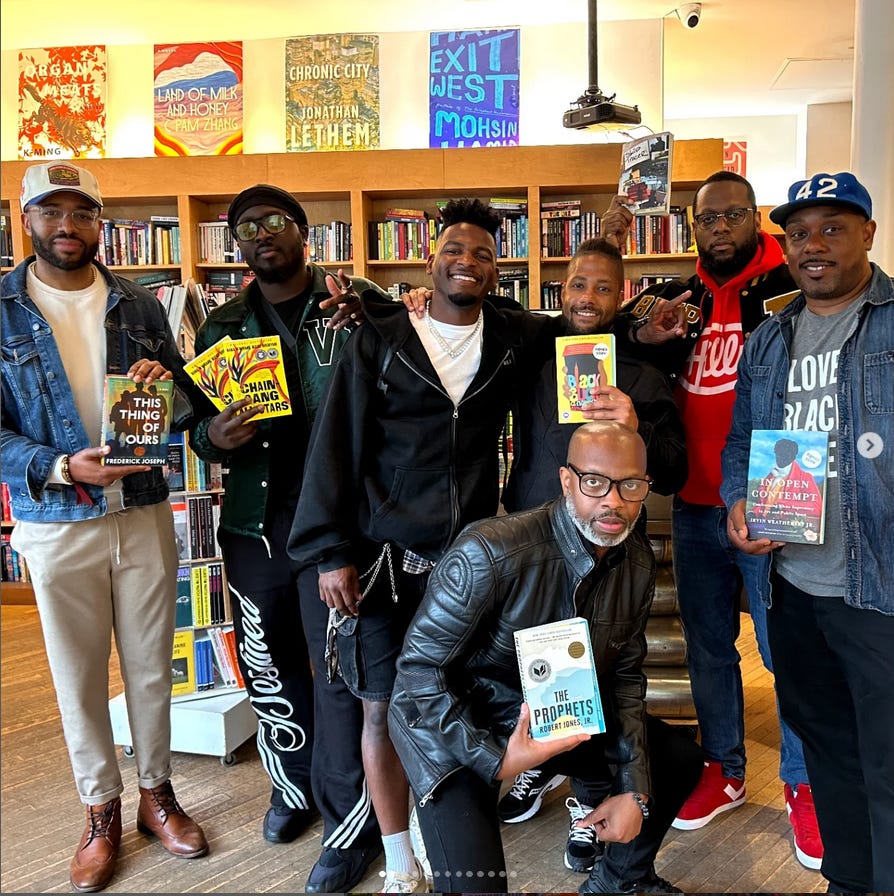
I’d like to draw your attention to some of my literary Brothers who have books out or on the way; Brothers who are writing for lives that people perform about, but don’t actually care about (unless it’s tied to revenue): their own.
I don’t want to give too much energy to this perennial conversation about how “Black men don’t read or write” because I see it for the anti-Black propaganda that it is. Every Brother I know reads and/or writes. Every single one. They may not read what you or I read; they may not write what you or I write. But they do both nonetheless—and often with great and unparalleled aplomb.
In fact, nothing can stop my Brothers from reading and writing. They read and write even as academic, media, and online discussion conspire to link individual tragedies together like chains to damn a demographic of hundreds of millions and collectively convict and sentence them all to being inherent terrors and irredeemable monsters worthy of any horror, including destruction. This sinister evaluation of Black men is at this point ancient. It’s older than the Trans-Atlantic slavery it was the point of. It’s a cunning white supremacist indoctrination that has never failed to seduce or kill. But now it’s utilized now under newer, more charming and collegiate aliases.
VanDyke Perry and Gregory Counts were convicted for rape, sodomy, and kidnapping over an incident that was purported to happen in Central Park in 1991. Perry served nine years in prison. Counts served 25 years in prison. They were exonerated after the accuser recanted her story.
My Brothers read and write even though they have shit to say that nobody wants to hear; things that everyone ignores, that everyone scoffs, cuts their eyes, and sucks their teeth at; things that everyone purposely misconstrues, that folks can’t wait to weaponize against them; things that others think they can speak over or in place of. They read and they write knowing that their testimonies implicate far too many people, including those who have lived their lives believing that they are way above implication. They read and right nonetheless, understanding that the response to them doing so will be violent and/or fatal. And the record is filled with the evidence of names: Makandal, Charles Bélair, Toussaint Louverture, Jean-Jacques Dessalines, Nat Turner, Denmark Vesey, King Cetshwayo kaMpande, Koitalel Arap Samoei, Patrice Lumumba, Medgar Evers, Malcolm X, Martin Luther King, Jr., Fred Hampton, Amílcar Cabral, Stephen Biko, Walter Rodney, Thomas Sankara, Deandre Joshua, Darren Seals, MarShawn McCarrel, Edward Crawford Jr., Danye Jones. And so many more lost to cover-up and forgetfulness. Or buried beneath piles of cash.
My Brothers read and write knowing that one of them will (not might) be next.

My Brothers read and write from the backwoods, knowing that telling truths from deep places might result in a variety of strange fruit. They even read and write from the living hell, the new slavery that we call the prison industrial complex. They write knowing that nearly 50% of missing Black people are Black men and boys and no one ever talks about that. They read and writing in the face of being 90-95% of Black people killed by the state. They read and write knowing that they are 96% of the Black prison population; that they, more than any other demographic in the United States, are the most likely to be falsely accused and wrongly convicted of violent crimes and drug offenses, and the most likely to die “deaths of despair.”
Why do they still read and write despite knowing all of this? I reckon it’s because Black men and boys understand more than most that there was a very good reason our forebears literally risked life and limb to learn how to read and write: liberation will eventually be discovered in these activities. And that’s why Black men and boys are the most discouraged from engaging in these endeavors to this very day.
What do I mean? Well, as I have written before: Fuck your vibes and your feelings; what the data and research show is:
The way we raise Black boys to become Black men is by telling them that their only value is in their income earning potential. That makes something like college, or scholastic learning period, seem to them like a too long/too-far-away investment. Black boys and men feel immense pressure to drop out of school, seek jobs, and earn money immediately (practically as young as babies). They enter the labor market way before they have a chance to develop their earning potential (or realize that their value is in the fact that they exist, not in what they can provide, the latter of which is a patriarchal idea). This leads to them trying to earn money as soon and quickly as possible; and they learn almost immediately that the streets are always hiring.
We then tell Black boys: “Shit, if you can’t fucking provide, then the least you can do is protect!” This, too, stems from the patriarchy everyone claims to hate and want to abolish, but embraces when convenient and self-serving. And we initiate and activate Black boys into “protecting,” which is another way of saying “make them hard,” teaching them that violence is the way to solve conflict. One of the problems with this is that we think we can channel or direct the violence such that they will only be violent toward the people we want them to be violent towards. But violence is the most unpredictable human act and the Universe cannot be fooled. Violence, therefore, is not like a gun, but like a boomerang. Certainly, it damages the target, but it damages the marksman, too. We’re happy to send Black men and boys off to war—whether that war is in the house, in the neighborhood, in the country, or in the world. And when they die, we say: That’s sad, but least they died doing the right thing. However, when they survive and they return to sender, we’re appalled to discover that there is no ceasefire for the war we declared inside of them, and these Black men and boys now see every situation as a battle and everyone in their sights an enemy combatant. In other words, we plant the seeds of toxic masculinity in Black boys from the moment they’re born and then have the fucking nerve to act victimized when the trees grow and bear fruit.
More than any other demographic, we (and by we, I mean family, friends, love interests, teachers, administrators, politicians, and law enforcement) tell Black boys from their earliest understandings, in ways that are both subtle and unconscious, as well as obvious and conscious, that they don’t have the potential to succeed and that they’re born failures—especially when it comes to academic pursuits. This negative expectation is called what Dr. Eddie Glaude, Jr. termed “the Value Gap.” Black boys then internalize this messaging only to then be blamed for being exactly what society encourages them to be.
In other words, when we say “Black men ain’t shit,” and we think that is encouraging Black men to “act right” (and what we mean by “act right” is in severe need of interrogation), it’s doing the opposite. The baby boys are hearing us. They think we’re giving them a blueprint for who they are and who they should be. They, therefore, conclude that they really ain’t shit—and worse, that they’re never going to be shit. They come to believe that they are more valuable dead than alive. (And, ironically, the Black Lives Matter movement proved that more than it disproved it.) And they begin to embody that expectation behaviorally.
(I must implicate the state here as well. Because it can’t seem to make up its mind. Sometimes, for nefarious reasons, it wants us dead. And sometimes, for nefarious reasons, it wants us alive.)
It’s important to note that Black boys perform much better academically when they have Black male teachers, who are the least likely to interpret Black boys’ regular childlike energy, rebelliousness, and verve as hostile, violent, or deadly behavior that requires the construction of a school-to-prison pipeline. The problem is that there aren’t enough Black male teachers. This is likely because all of us teach Black boys weird forms of masculine identity such that many of them grow up believing that teaching is a passive occupation and they fear being seen as weak if they take it on. And the last thing they want to be seen as is weak. Because they know that there’s nothing people loathe more than a weak Black man (even if weakness is the fundamental state of the human condition).
Frederick Joseph discusses masculinity on The New York Times’ “The Opinions” Podcast, 2026.
In her book Post-Traumatic Slave Syndrome, Dr. Joy DeGruy explains that we can trace the endlessly harsh treatment of Black men and boys to the plantation system of antebellum slavery, where it served a dual purpose. Ain’t shit was used by Black people as a strategy to convince white plantation owners that Black men and boys were of little to no value in an effort to protect them from being overworked or sold (or, conversely, to prepare Black men and boys for the distinct possibility that they would be overworked or sold so that when those things occurred, they could expect and perhaps survive them). Whereas, harsh treatment from white people was designed to break Black men and boys, make them docile and obedient despite being physically strong, and force them to labor ceaselessly until they died. John Henryism is real and continues to be.
In the case of the way white people treat Black men and boys, the anti-Blackness is easy to identify. That same anti-Blackness isn’t as clearly seen when Black people treat Black men and boys in identical ways. But what once may have been practical is now absolutely pathological. It’s the thing that’s causing Black men to lead in almost every measurable category of premature death. It has gone from a kind of protection under duress to what can only be described as a deep, abiding, and overwhelming hatred of Black men and boys. That this is denied, disputed, shunned, silenced, overlooked, or looked down upon says nothing about Black men and boys, and everything about the folks towing the master’s line.
But despite all of this, Black men read and write. Or they want to. Or they try to. Under conditions that would have forced anybody else to crumble. And I want to bring their works to you because I can read the signs and interpret the portents. And I can see the direction American literature is headed due to the resurgence of Jim Crow, the devious qualities of late-stage capitalism, and how easily cowards bend before tyrants.
I wish I knew the number of writers who wrote something brilliant that they were forced to make pedestrian (or clownish or cliche or stereotypical or garbage) so that an American audience that refuses to grow up could remain blissfully coddled and distracted. I wish I could read their first drafts. I wish I knew the number of writers who have never been published because some buffoon in a fancy suit who wishes they could write that well didn’t think a genius’s books would sell. I wish I could read what’s trapped on their flash drives. Matterfact: Moby-Dick didn’t sell well at first. It took over a hundred years, but now it’s an American staple, right? Considered one of the great classics (probably because most of the people reading it don’t know that it’s one of the earliest critiques of whiteness by a white person on record), and Herman Melville is heralded as one of the greatest writers of all time.
And that’s one of the things capitalists hate most: time. They exist in a perpetual state of right this instant. Short memories and even shorter insight. And there’s no courage to be found anywhere in them, they who contemplated leaping from skyscrapers because a ticker-tape read their palms and came up empty. We call them capitalists now, but I think what we used to call them speaks much more clearly to who and what they are: robber barons. Because they rob us of the dream we could have been and damn us to nightmare that what we’ve become. Whatever it is we call them, it’s very difficult to be an artist in their presence. They’re a cutthroat people with heartless desires who can only interpret us as commodities. They have no capacity to dream of anything other than money. And while art and commerce have long been bedfellows, they are, I think, ultimately at odds.
Clips from the Donald J. Trump biopic, The Apprentice, outline the psychopathy of the robber baron’s mentality and tactics.
Take someone like Charlotte Osgood Mason, for example. Missy Charlotte was a wealthy white philanthropist from the early 20th century who gave over $100,000 ($1 million in today’s funds) to Black artists of the Harlem Renaissance Era out of everything except the goodness of her heart, wherein there might not have actually been any goodness at all. For, you see, Missy Charlotte had an agenda:
“Mason has been criticized for trying to control the work of the writers she supported. She insisted on being called ‘Godmother,’ and she developed intricate and controlling relationships with the people she helped. She is cited in Zora and Langston: A Story of Friendship and Betrayal by Yuval Taylor (2020). Black feminist scholar bell hooks writes critically of the relationship between Mason and Hurston: ‘It is difficult to believe that Hurston was blind to the cultural imperialism, the white supremacy of her sponsor, Mrs. Mason. This ‘world’s most gallant woman’ had compelled Hurston to sign a legal agreement which specified that all material she gathered would be the legal property of her patron and that Hurston could use such material only when granted permission.’ Scholars such as hooks and Irma McClaurin argue that because of Mason’s financial support of Hurston she enforced specific themes and subjects onto Hurston’s work. One explicit area of interest Mason pushed on Hurston was the notion of finding the ‘authentic’ Black life or culture and writing about it. McClaurin states though that by doing so the ‘authentic’ Black life or culture is judged by Mason’s white standard and understanding. She becomes the ‘arbiter of authenticity.’
Mason’s controlling patronage can also be seen in her relationship with Langston Hughes. Beginning in 1927, Mason subsidized Hughes for three years. Mason believed that Langston could express her own ideas about the ‘primitive’ in his writing. In their relationship, Mason controlled more than his writing by dictating the music he was allowed to listen to and the books he was allowed to read. Mason asked that he write only to her, further isolating him from any influence that was not her own. After three years of her patronage, Hughes cut ties with Mason. When their relationship ended, Mason predicted that Hughes would fall and reminded him that his accomplishments so far would have been nothing without her support. This ‘unpleasant goodbye’ was ‘traumatic for Hughes and irrevocable for both concerned.”
Langston Hughes is me. I’m Langston Hughes.
Unfortunately, this patronizing mentality (where a non-Black person asks a Black person for an analysis, confirmation, depiction, or performance of “authentic Blackness,” and what they mean is by “authentic” is the boogeyman/savage/mammy/welfare-queen lowercase-blackness made-up wholesale by white folks in order to give white people a reason to feel superior to Black people) is not some relic of a distant past. It’s alive and well in 2026. Author Chris Stuck testifies to a situation wherein the white professionals (professional whats is in serious need of discussion) he encounters—who consider themselves liberal, fair, and well-intentioned—remain as committed to particular portrayals of Black people and Black life as any other racist might. But they would argue you down about how they don’t have a racist bone in their bodies (their blood, hearts, minds, and spirits, however...):
All this ended up in a novel I lived by day and wrote by night. It wasn’t the greatest book in the world, but it was good enough to get me into graduate school months later and a few writing residencies after that. I eventually sent it to an agent named Warren Frazier at John Hawkins and Associates, and he liked it. But he was cautious. He wanted fast money with little effort. If it sold over the weekend, great. Going through drafts and sending it out for months and months wasn’t something he wanted to do. To be fair, it was probably rough. I was twenty-six, and I wanted to publish a book badly so I said okay. He sent an exclusive submission to Sean McDonald at Farrar, Strauss, and Giroux (FSG), who was snatching up gritty books left and right at the time. Sean liked it enough to have a conference call. But he wanted to know if the main character, based on my brother, was actually me. If so, he was ready to work.
Obviously, it was not. On the phone, I could tell he hoped I was some down and out hustler with a heart of gold, who could write halfway okay too. I said, ‘You both like the book well enough, though, right?’ Frazier said sure but having an authentic backstory was the only way the book would work. This was in 2004. People liked knowing the book was based on the author’s life. Books flew off the shelves that way. Not much has changed. (Hello, autofiction.) ‘What about imagination and making stuff up though?’ I said. I based the book on my brother, but I invented a whole narrative and characters out of thin air. What about that shit? From what I remember (I was a pothead, let’s not forget, my memory might be fuzzy), Frazier and McDonald both thought imagination was great but it didn’t sell. Your backstory had to match the book. If the backstory was intriguing enough, the book almost didn’t matter. It was the first time I’d heard industry people talk like this. My first brush with the publishing world. I had to go smoke a fatty after.
They will sometimes even go as far as representing Black life and culture themselves, as though they are just as expert on Blackness as Black people actually living in, out, through, and under it. As author Mateo Askaripour wrote recently:
This is because nearly 150 years ago, Harris, a white man, soaked up the West African-descended folklore of Brer Rabbit from enslaved men and women, and published these stories to critical acclaim and fame, even receiving a personal thank-you from President Theodore Roosevelt. We continue to see this mind-boggling pattern today, one of white writers, however well-meaning, telling Black stories, being awarded at the highest levels, and cracking an already overwhelmingly white best-seller list.
They think they’re authorities. I think they’re confused. As Baldwin once said, what white people invented was niggers, and that’s what they’re conflating with Blackness. That’s what they’re primed to accept as Blackness. That’s what they desire Blackness to be. That’s what they want Blackness portrayed as. In those depictions is where they find comfort, definition, ego-boost, and safety. But their inventions ain’t nothing like the real thing, baby. Their inventions are not Blackness. Their inventions reveal absolutely nothing about Black people; but they do reveal everything—and I do mean everything—about white people.
James Baldwin discusses the origin and purpose of the word “nigger” in a clip from the documentary film, Take This Hammer (1964).
The fundamental split is this:
Artists have vision. We wish to express whatever it is our Ancestor-given, Universe-spawned talents call upon us to express. Whether it’s beauty, ugliness, or something heretofore unseen, the artist attempts to render reality in a way that causes the rest of the species to pause, self-reflect, recognize our shared conditions and experiences; and from that, attempt to finally live up to the best of what it means to be human(e), rather than lazily wallow in the worst.
Capitalists, on the other hand, are myopic. All they have access to is avarice. Where creativity should have animated their bodies, the diabolical flows instead. They seek only to exploit, hoard, steal, destroy. They buy and sell everything: land, children, air, sex, water, risk, oppression, health, the universe, bridges, death. The closest they can come to anything that could be mistaken for love if you’re not careful is how they feel about profit.
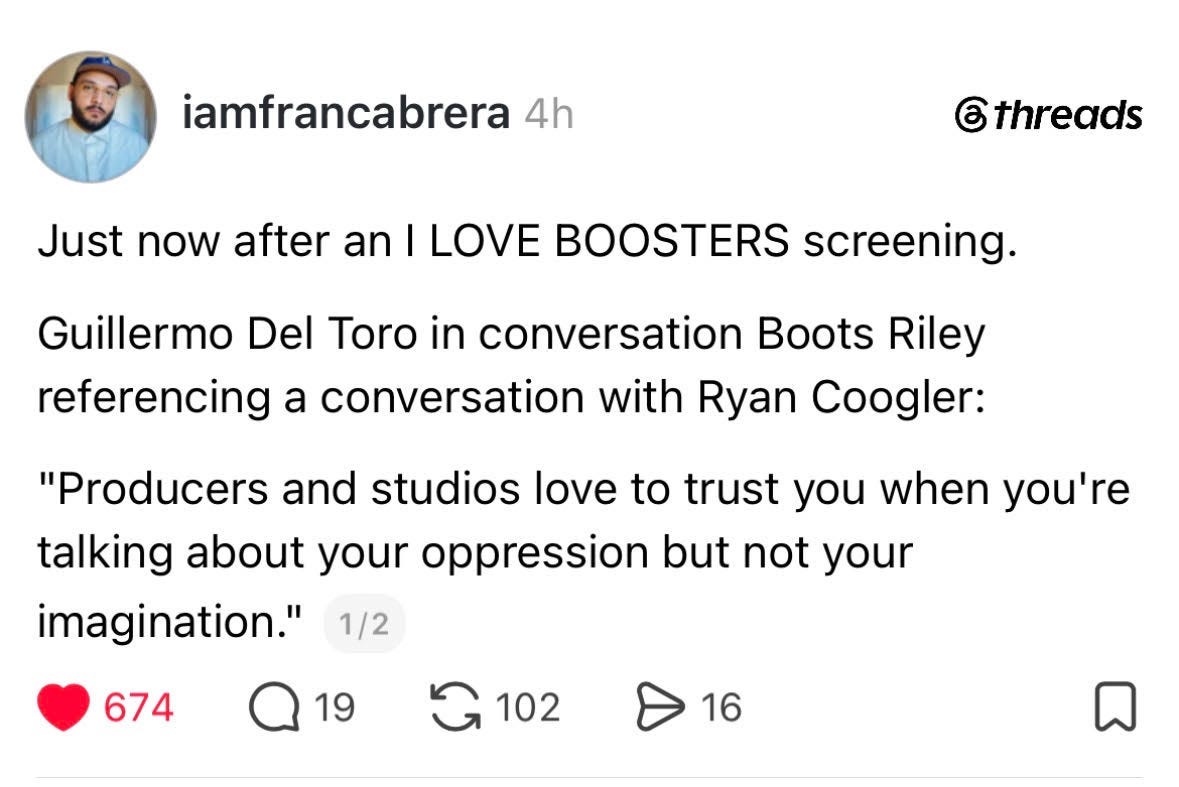
Filmmaker Fran Cabrera-Feo conveying on Threads a truth shared between filmmakers Guillermo Del Toro, Boots Riley, and Ryan Coogler.
Where artists attempt to deepen humanity, capitalists attempt to mechanize it. Artists say your value is inherent and that to be valuable, you don’t have to do anything more than exist. Capitalists say you’re not even as valuable as what your next act of labor will earn them. Capitalists incite wars because they economically benefit from them. Artists challenge the ways in which de-personalization is encouraged so that on a commander’s order (and that commander can be both external and internal), a person can actually pick up a rifle, point it at the face of another, pull the trigger and only think about the consequences of that action once it rises to haunt them. And by then, it’s too late.
Capitalists fund oppressive regimes, genocides, and world-poisoning ventures. Artists reveal who the real enemy is and that’s why art is so contentious and why people in power wish to first vet, then alter art so that its messages don’t pose a threat to their plunderous agendas. This is why Trump and the MAGA cult, under the auspices of their Project 2025 manifesto, immediately sought to de-fund actual artists and offer support to state-sanctioned propagandists (or anti-artists). This is why the publishing industry is setting up camp on the wrong side of history. They say it’s just business, like that’s an excuse and not a confession. The goal is to get us to think that this fucked-up, man-made game of fools is the default, natural, normal, immutable, desirable condition of existence.
But it’s not.
Toni Morrison in conversation with Sonia Sanchez and Ta-Nehisi Coates at the Stella Adler Studio of Acting for the Harold Clurman Lecture Series, “Art and Social Justice,” 2016.
They claim that The North remembers, but I don’t ever hear anyone asking what it is that it remembers precisely—or, more importantly, what it has forgotten. The artist’s purpose, therefore, is to remind; to, as Toni Morrison once put it, rememory. I don’t know if that makes artist the most dangerous profession imaginable, but it certainly does make it so that when it’s practiced properly (which is to say, when it’s aimed squarely upward), it can get you murked. And there are many ways in which overlords accomplish this. Starvation is their most potent weapon, but they’re not above paying people you thought you could trust to play you close, spike your drink, stab you in the back, or strangle you in your sleep.
So stay woke.
And Brothers: Don’t worry about being published. Just write your shit.
Write! Your! Fucking! Shit!
II. Black Men Writing
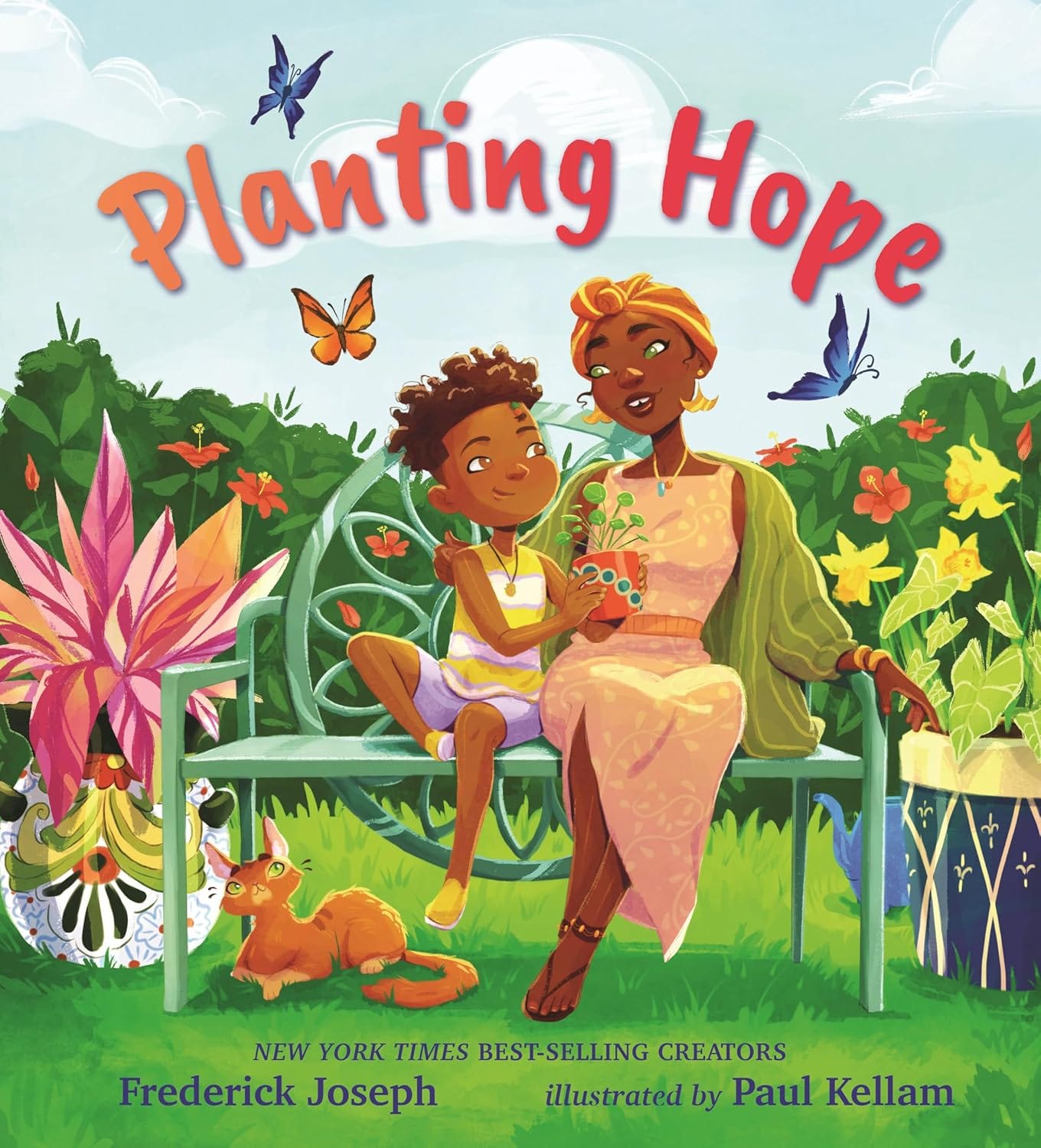
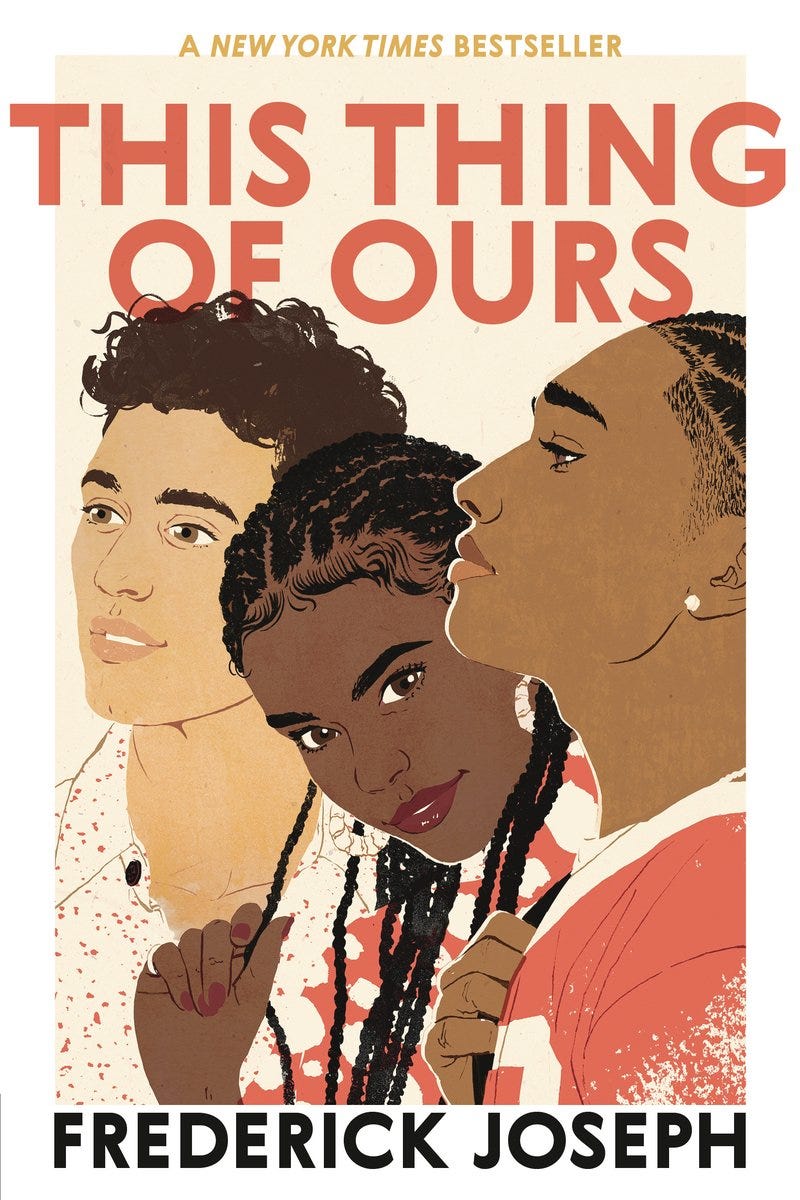
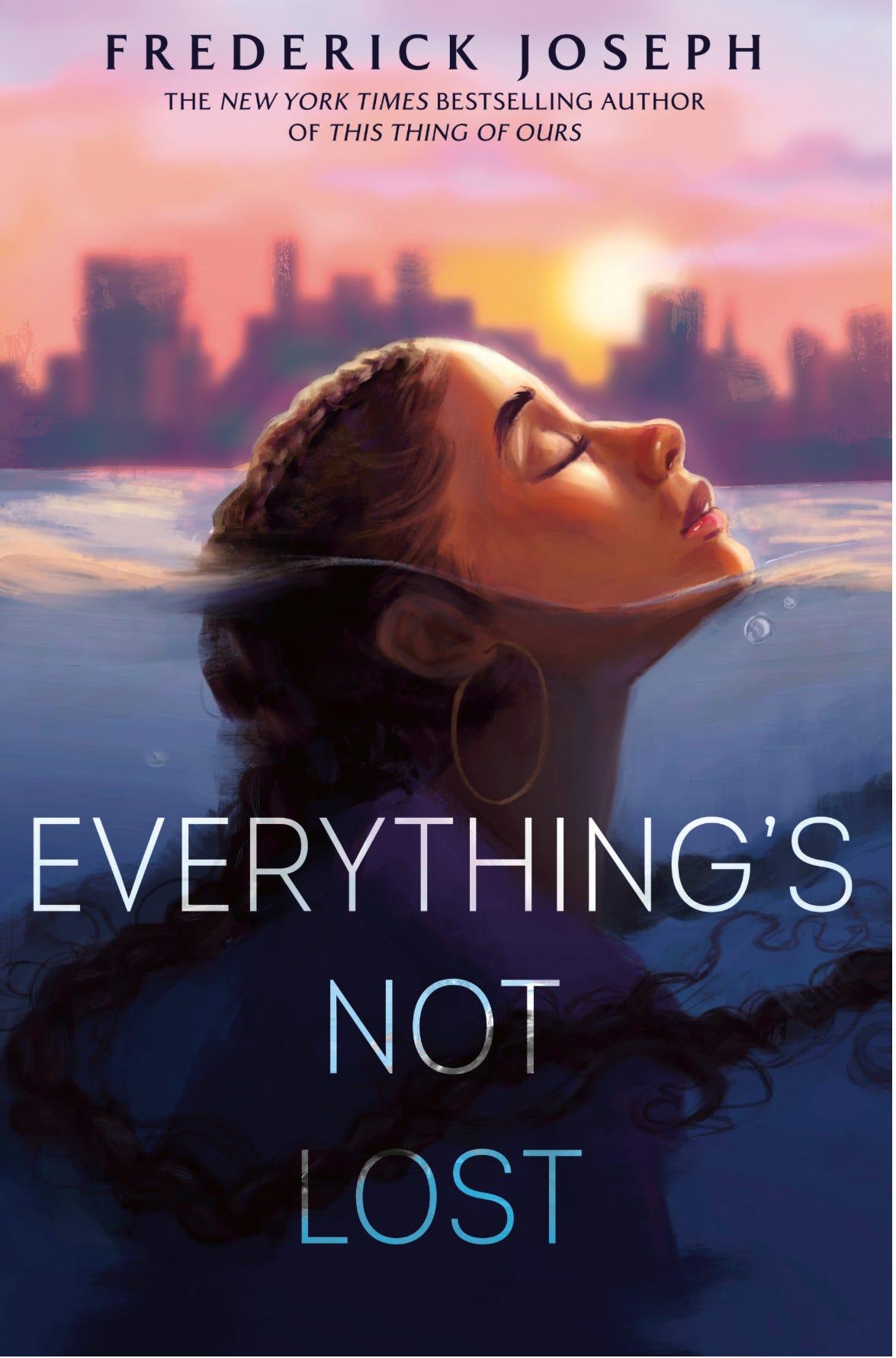
Frederick Joseph is one of those writers that makes you wonder how he does it. He writes brilliantly in any genre you throw at him: fiction, nonfiction, poetry, comic books, you name it. In addition to being a community organizer, he’s the award-winning author of a gang of books: The Black Friend: On Being a Better White Person, Patriarchy Blues: Reflections on Manhood (my personal favorite, of which I said: “In Patriarchy's Blues: Reflections on Manhood, Frederick Joseph deftly peels away the layers of innocence we all attempt to cling to when confronted with our own complicity in harmful paradigms, providing a blueprint for how we might be able to reclaim ourselves by replacing the horrors of domination with projects of radical compassion, empathy, vulnerability, and self-inventory--which is to say, finally become human. Joseph has learned a great deal from bell hooks here, and I think she would be proud because Patriarchy Blues is such a moving, inspiring, rigorous vision for living.”), Black Panther: Wakanda Forever – The Courage to Dream, We Alive, Beloved, and This Thing of Ours. He recently released his second picture book, Planting Hope, and the paperback version of his debut YA novel, This Thing of Ours, is finally available. Described in a starred review from Publisher’s Weekly as “[b]oth heartening and heartbreaking, this richly layered, sensitive YA fiction debut from Joseph unflinchingly confronts systemic racism, classism, and homophobia via a powerful story of self-discovery and social justice that aims, shoots, and scores,” This Thing of Ours is also a New York Times instant bestseller.
And because Frederick can’t do nothing but write his ass off, he has yet another book hitting the stands on October 20, 2026, called Everything’s Not Lost. The novel is described as follows:
As a sixteen-year-old Black girl with bipolar disorder, Ella Washington has plenty stacked against her. But following her beloved sister’s unexpected death and its turbulent aftermath, Ella is desperate to find any sense of normalcy. Worse still, someone at her school is determined to drive her deeper into despair.
It feels nearly impossible to find her way out of the fog of grief and loneliness, but through her love of art, some unlikely new friends, and the memory of her sister, Ella slowly learns that the pursuit of happiness and forgiveness is an endeavor that is more than worthwhile.
Told in Frederick Joseph’s perceptive and lyrical voice, Everything’s Not Lost is an achingly relatable story about finding points of light even in the darkest of times.
And this is what iconic and award-winning author Jacqueline Woodson had to say about it: “Frederick is such a grounded and beautiful voice of not just this moment but all the moments. Everything’s Not Lost cements him firmly as a much needed and stunning voice inside the world of YA literature.”
You can purchase Planting Hope: HERE.
You can purchase This Thing of Ours: HERE.
You can pre-order your copy of Everything’s Not Lost: HERE.
To learn more about Fred and his work, visit his website: HERE.
You can subscribe to Fred’s Substack: HERE.
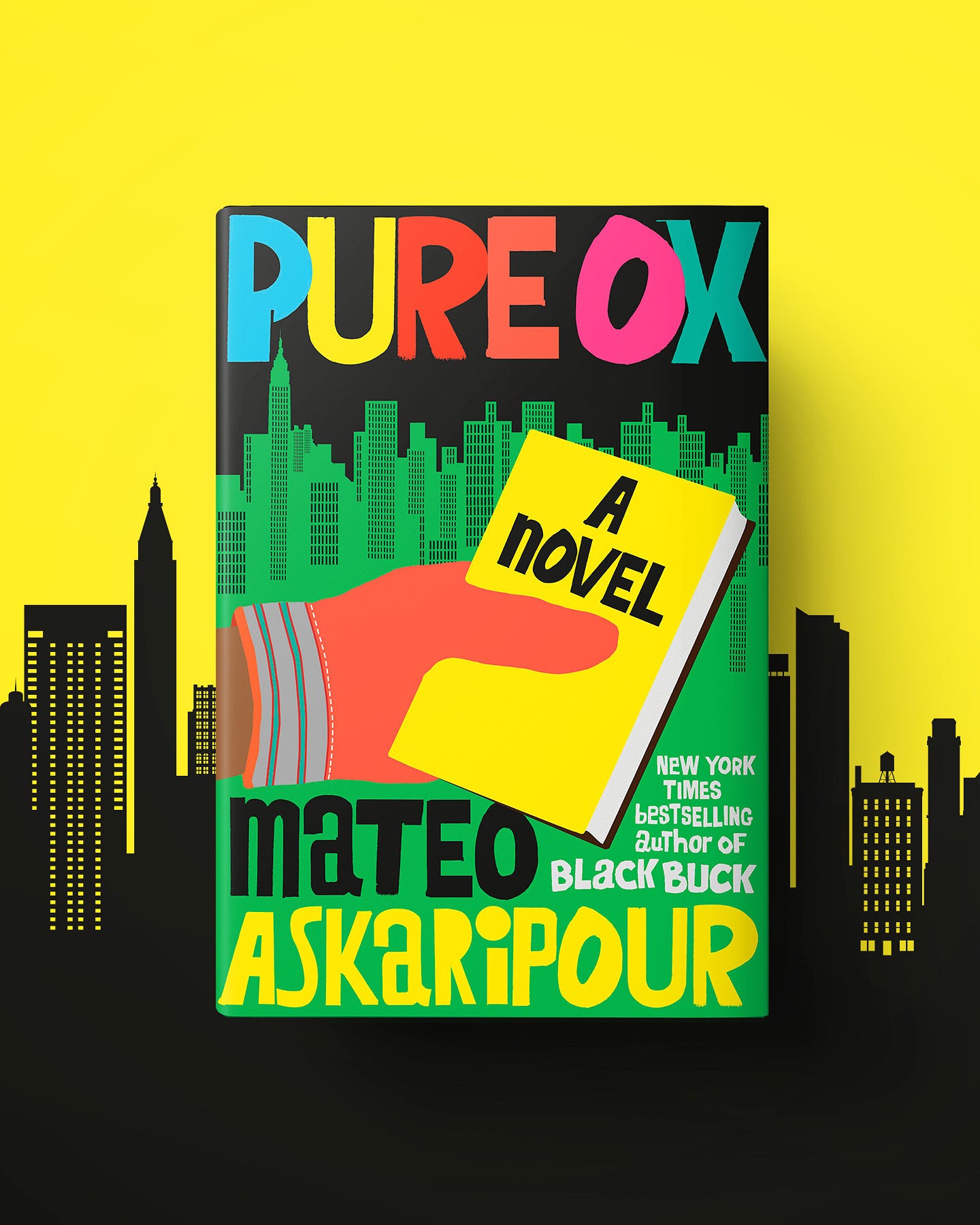
That cover is crazy!
You already know Mateo Askaripour don’t play around. He’s one of the most daring writers I’ve ever come across. A New York Times bestselling and award-winning author with an imagination like wildfire and who’s completely peerless when it comes to putting pen to paper, one of Mateo’s most potent literary gifts lies in his ability to find the funny to highlight the fucked-up. My favorite work by him is his second novel, This Great Hemisphere, which is an astounding speculative fiction tale and I have secondhand embarrassment for those of you who slept on it. Like I said: “Mateo Askaripour’s This Great Hemisphere is a wildly imaginative novel, bursting with cinematic fervor. The world-building here is meticulous and astounding. The characters are so well-realized that they haunt the heart, motivate the mind, and shake the soul. The story itself strikes the perfect balance between wisdom and warning. I can’t help but to think that the spirit of the great prophet Octavia Butler hovers over This Great Hemisphere. And quiet as it’s kept, Mateo Askaripour just might be that level of oracle, too. This is a fiery must-read.” And he’s got a new joint coming out on January 5, 2027 (which is the sixth anniversary of his debut novel, Black Buck). It’s called Pure Ox. (Ain’t that title fire?)
You’ve never noticed Ox, but Ox has noticed you. Waking before sunrise, he works long hours loading a nineteen-ton collection truck that he and his friend and shift partner, La Reina, drive along the streets of Brooklyn. He fiercely loves his job and being of service to others, but his biggest dream has always been to be a writer—to write one good book.
Ox’s dream meets reality when he discovers that a high-powered literary agent has moved into a house on his pick-up route, and La Reina convinces him to leave a copy of his manuscript on her doorstep. Soon, Ox is being wined and dined by every major publisher, fighting to make sense of an industry that wants what he has, even if it doesn’t exactly welcome him with open arms.
But when sanitation workers go on strike, Ox is forced to contend with the steep price of success and whether the duty we have to others is stronger than our duty to ourselves.
Brimming with hope and humor, Pure Ox is an unforgettable story centered around one question: How can we make the most of our lives and not waste a second?
You can pre-order your copy of Pure Ox: HERE.
To learn more about Mateo and his work, visit his website: HERE.
You can subscribe to Mateo’s Substack: HERE.
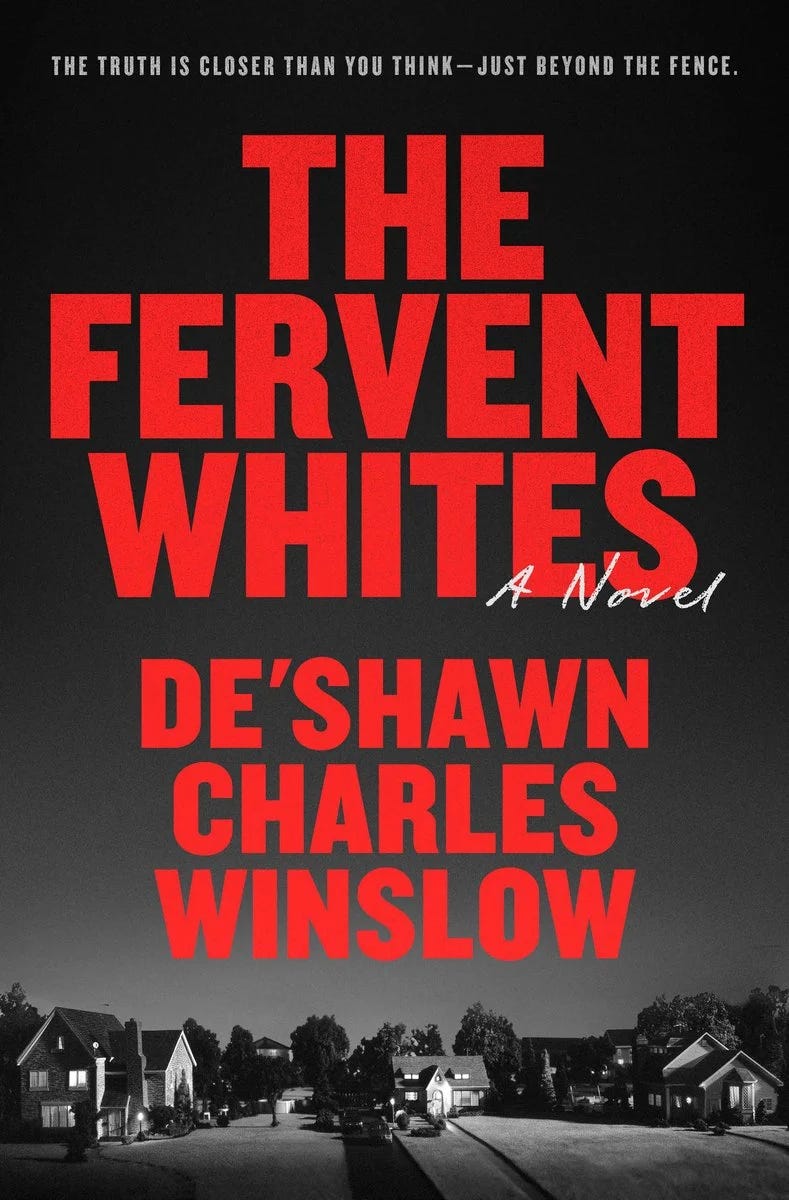
My Brother De’Shawn Charles Winslow is the award-winning author of the novels In West Mills and Decent People. As I wrote in my blurb for the latter: “One of De'Shawn Charles Winslow's greatest gifts is his world-building mastery. West Mills and the people who reside in it feel so real, recognizable, tangible, vibrant, and vivid. His rendering of this southern landscape is extraordinary. And this skill serves Decent People very well. It's been a very long time since I've read a good, old-fashioned whodunnit, and this is a most outstanding one, accomplishing several feats at once: it's a compelling mystery with brilliant misdirections and surprising revelations, all while having depth of purpose and critical, crucial social commentary. Decent People is quite the achievement.” In addition to being a genius at world-building and drama, he’s also a remarkably versatile writer who can give you high literature one day and messy murder mystery the next, leaving you gagging in both instances. And I’m excited to say that he has a new novel coming out on June 9, 2026. It’s called The Fervent Whites.
The truth is closer than you think—just beyond the fence.
The year is 1982, and the people of the Hudson Valley community of Fervent have begun to move on from a homicide that upended the once quiet town. When the former neighbors who were convicted of the crime, James and Ella White, are proven innocent, released from prison, and return to Fervent, some people have cause for concern.
Sylvia Upshaw and her best friend, Lafayette “Fate” Jolly, are uneasy about the Whites’ return. While the Whites were incarcerated, Sylvia revealed an explosive secret to their adopted son, Morgan, with devastating consequences. During the murder trial, Fate’s testimony helped seal their fate. James and Ella won’t let the betrayals go unpunished. Sylvia and Fate quickly become victims of harassment from the Whites, and when another murder is committed in Fervent, the town is left to fend for itself.
Intimate and chilling, The Fervent Whites examines how small communities with long-simmering tensions behave when pushed to the limits of civility.
In a starred review, Publishers Weekly said: “Winslow gracefully weaves in story lines concerning lingering pushback over integration in the area and the recent arrest of a white supremacist serial killer. A stunning climax and rich atmosphere ensure this makes a major impression. It’s a gut punch of a novel.”
You can pre-order your copy of The Fervent Whites: HERE.
To learn more about De’Shawn and his work, visit his website: HERE.
You can subscribe to De’Shawn’s Substack: HERE.
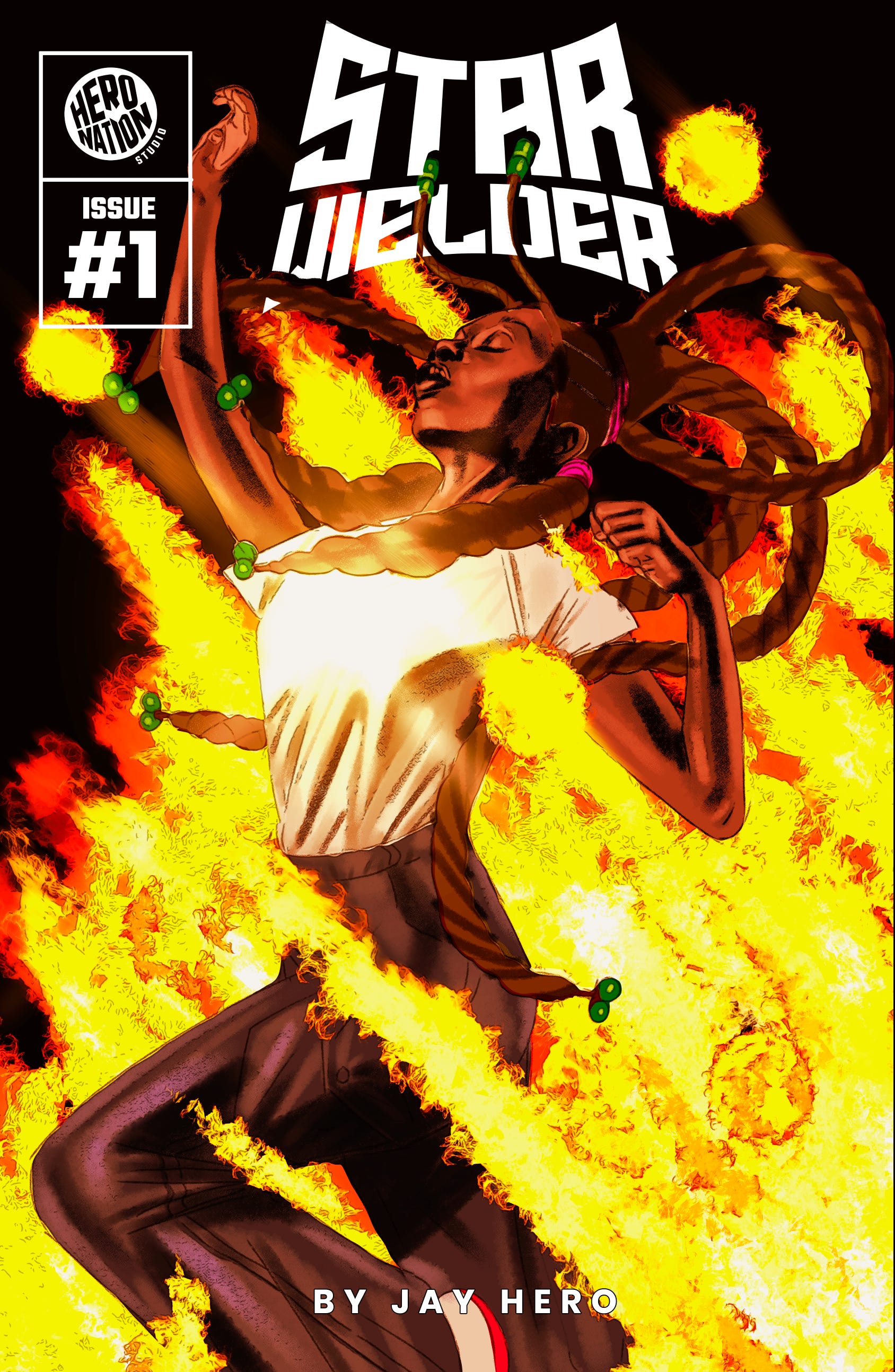
My Brother Jay Hero, an extraordinarily talented artist and now writer, is about to release his first comic book series. It’s called Star Wielder.
Star Wielder follows the story of Kiara Kelly, a pyrophobic girl from the City of Courage, Detroit, who, while facing the tragic death of her adoptive Grandmother and dealing with past trauma, through her grief, discovers her mysterious fiery abilities.
Kiara is compassionate and resilient in ways that mirror her vibrant home city, Detroit. She longs to live a normal life, following in her grandmother’s footsteps, growing, healing, and protecting her community. Yet, instead, her life is overshadowed by unprecedented circumstances, including her pyrophobia—a deep-seated fear stemming from a horrific fiery tragedy in her childhood. But when Kiara suddenly manifests flame-wielding abilities, this forces her to question her humanity. And as a menacing threat looms over Detroit, Kiara must make an impossible choice.
Star Wielder will arrive on November 27, 2026, from Hero Nation Studio—a creative studio that champions stories and art centering Black and brown people through the realms of speculative fiction.
You can read a preview of Star Wielder: HERE.
You will be able to eventually purchase a copy: HERE.
To learn more about Jay and his work, visit his website: HERE.
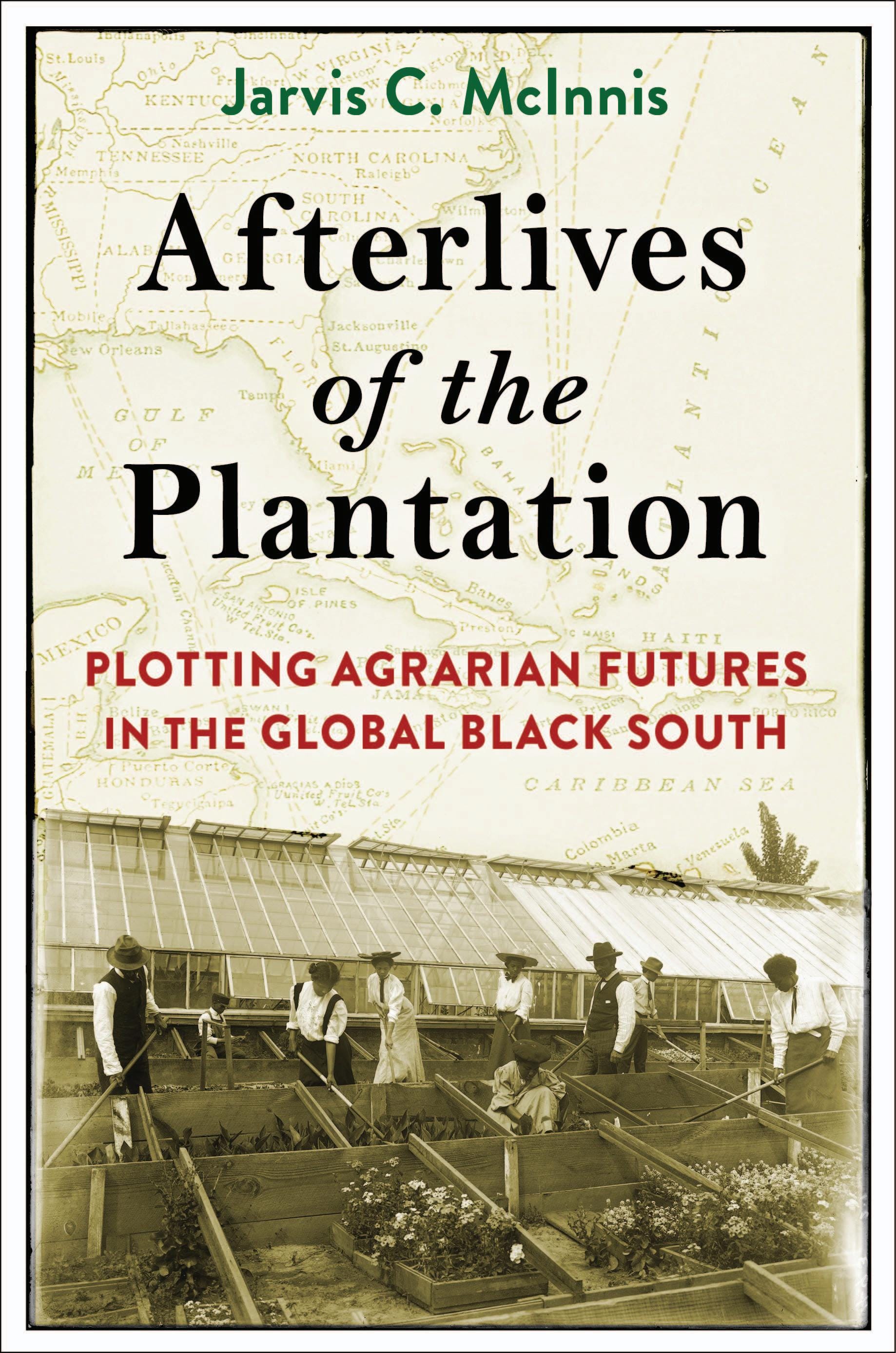
I had the pleasure of meeting Dr. Jarvis C. McInnis at the recent Jesmyn Ward event I moderated in New Orleans on May 19 (I’ll be discussing my experience of meeting Professor Ward in a future post; stay tuned!). His scholarly work, Afterlives of the Plantation: Plotting Agrarian Futures in the Global Black South, is the winner of Pauli Murray Book Prize in Black Intellectual History, the ASALH Book Prize, and the 2025 On the Brinck Book Award.
Built on the grounds of a former cotton plantation, the Tuskegee Institute, founded by Booker T. Washington, offered agricultural and industrial education as a strategy for Black self-determination. There—and in many other communities in the U.S. South, the Caribbean, and Central America—Black people repurposed and regenerated what had been a place of enslavement into a site for imagining alternative futures.
Jarvis C. McInnis charts a new account of Black modernity by centering Tuskegee’s vision of agrarian worldmaking. He traces the diasporic ties and networks of exchange that linked Black communities in the late nineteenth and early twentieth centuries. Although Washington is often regarded as an accommodationist, McInnis shows how artists, intellectuals, and political leaders—including George Washington Carver, Jean Price-Mars, Zora Neale Hurston, Claude McKay, and Marcus Garvey—adapted Tuskegee’s methods into dynamic strategies for liberation in places like Cuba, Puerto Rico, Haiti, and Jamaica. Even as the legacy of the plantation continued to circumscribe Black life, these thinkers found resources in its ruins to forge new theories and practices of progress, aesthetic innovation, and freedom that contributed to the New Negro Movement of the 1920s and 1930s.
In contrast to traditional understandings of Black modernity as urban and premised on northward migration, McInnis foregrounds rural settings and practices of place making, rootedness, and liberatory agriculture. Shedding new light on the transnational influence of a historically Black institution in the U.S. South, Afterlives of the Plantation remaps Black cultural, intellectual, and political histories down to the very soil.
You can order your copy of Afterlives of the Plantation: Plotting Agrarian Futures in the Global Black South: HERE.
To learn more about Dr. McInnis and his work, visit his website: HERE.
Last, but not at all least:
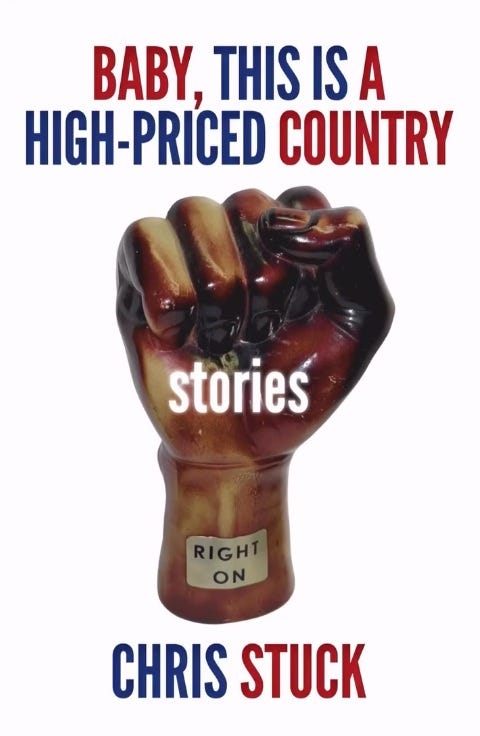
There’s a certain fearlessness that comes with reaching your 50s, where not giving a fuck stops being just a throwaway phrase and becomes a meditation, a practice, a reflex or instinct, if you will. Imagine being a Black writer of immense talent being gaslit by the American publishing industry, an industry that neither sees nor understands you, to believe that your literary skill is immaterial compared to market demands (and by “market,” they mean white people). Imagine having the gumption to say in return: “Aight. Bet. Fuck you and the market!” And after rigorous foot-to-pavement research and an exhaustive review of the options, coming to the only conclusion that makes sense: having faith in yourself and your abilities. Imagine taking the risk to self-publish in a world that views self-publishing as a no-win, cowardly, sloppy, inelegant, shameful, lesser, illegitimate, unprofessional, and reckless endeavor for trash authors and other failures who weren’t good enough to be stamped and approved by the one-percenters. Well, that’s exactly what Chris Stuck did. And his courage and conviction are exceedingly rare (and that rarity is rooted in a fear promoted by the system). But it’s also extraordinarily inspiring. You may know Chris as the award-winning author of the short story collection, Give My Love to the Savages. His new set of stories will be released through the company he started in order to publish his own books, Black Heroics Book Co, for “Imaginative Black literature corporate publishers are too scared to publish or too stupid to understand.” The collection is called Baby, This Is a High-Priced Country.
A potent collection of twelve wildly inventive stories that explore race and white supremacy, love and war, and the predicament of being a person of color. From a Black man moving to The Whitest City in America and unwittingly befriending a diversity robot, to the oldest employee at White Supremacy Incorporated pondering retirement just as the company goes public, to a film crew trying to complete a doomed production called Racism: The Movie, Stuck’s stories showcase extraordinary depth and rich imagination, slyly fusing humor, satire, absurdism, and realism into a powerful work of fiction that can only be described as American as fuck.
P.S. Where’s the lie in that title? And he designed the cover himself!
I’ve always admired Chris’s work and his fire. I bought his first collection the minute it dropped because Brother Mateo bigged it up, saying: “Stuck brings nuance and empathy to each page, letting you know that he, like his characters, is traveling inward to find answers to questions of existence, rather than consulting some fictitious Encyclopedia Blacktannica. This is a collection full of movement, of intelligent people traveling to new places or returning to old ones, leading to discoveries about themselves, about family and about the places they call home. Chris Stuck is a writer who has spent much time pondering the human condition, and we are the beneficiaries of his labor.” Chris is an exceptional writer and I find it of the utmost importance to support his work—especially now. Because, yes, I feel like something must be shown and yes, I believe something must be proven. When a writer of Chris’s caliber chooses to escape the machine and self-publish due to the fact that some agency was appalled that they couldn’t cannibalize his Blackness, that, to me, is a call to action. Whether the book sells or not (and I hope people have enough sense to make sure it does), Chris will continue to write because he understands that it’s his purpose. And purpose doesn’t require a co-sign.
Baby, This Is a High-Priced Country will be available for pre-order on July 1, 2026 and on sale beginning August 25, 2026. To purchase it, visit the Black Heroics Book Co. website: HERE.
To learn more about Chris’s journey to self-publishing, read his essay, “Chasing Wild Geese Through the Corporate Book World, or How I Became a Hack and Started Self-Publishing My Fiction”: HERE.
To learn more about Chris and his works, visit his website: HERE.
You can subscribe to Chris’s Substack: HERE.
If you want to contact Chris directly for promotion or just to ask him shit about his bravery, strategy, and what it feels like to be an iconoclast, you can email him at editors@blackheroicsbookco.com.
The last thing I will say is this:
Please buy Black men’s books.