
Hap-py Birth-day to Ya, Baba Baldwin!
The Stevie Wonder version only. If you know, you know. :)

Welcome to Witness, a reader-supported publication where I write in the traditions of Black resistance, survival, and truth-telling in an age of artistic and political suppression, and rampant deception. If you find something of value here, please consider becoming a paid subscriber if you can afford to do so (and if you do, leave a little note as to why you did so). I know times are hard as fuck since Trump and MAGA’s policies have raised costs and prices across the board for those of us who aren’t wealthy. So, if you can’t, you can’t; I understand. I still appreciate you and I’m still glad you’re here. Thank you. And blessings!

“Crunch had all his teeth then; but for years before he was carried away, the two front teeth were missing. A cop had kicked them out, a Black cop; and because it was a Black cop who had attempted to destroy him, Crunch never had his teeth replaced. He could have; he was into every hustle, he was smart, and he was ruthless. But, no: he wanted Black people to see what Black people did to Black people: White man couldn’t touch us if we’d just learn to love each other!”
— James Baldwin, Just Above My Head (1979)
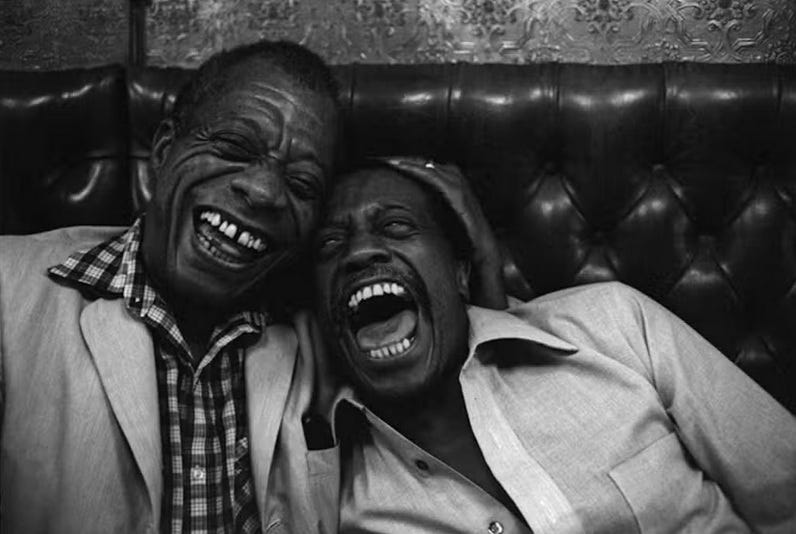
Today marks the 102nd birth anniversary of the magnificent genius and legendary icon known as James Baldwin.
As I celebrate this occasion in my own way—for my Baba, who was and still is, in a myriad of ways, my greatest teacher outside of experience itself, for I have learned from both his wisdom and his errors, and I don’t think he would have it any other way—I would like to share something with you.
In what is one of the highest blessings of my life so far, I was asked by The Baldwin Estate and Vintage International/Vintage Books to write the introduction to the First Vintage International Edition of the re-release of Just Above My Head, Baldwin’s final novel. Ellie Pritchett, who was my editor on the project, was an absolute joy to work with. I feel that I must say that publicly because, from what I’ve been told, to be in collaboration with an editor of her level of perception and talent has become increasingly rare in publishing. We are living in an age where editing is a dying (and woefully underfunded) art form; where editors are expected to be sales-predictors rather than artists. So, it’s always a gift to come across exceptions.
My hope and prayer is that the introduction does Baldwin, his work, and his legacy justice, and lives up to his indelible memory.
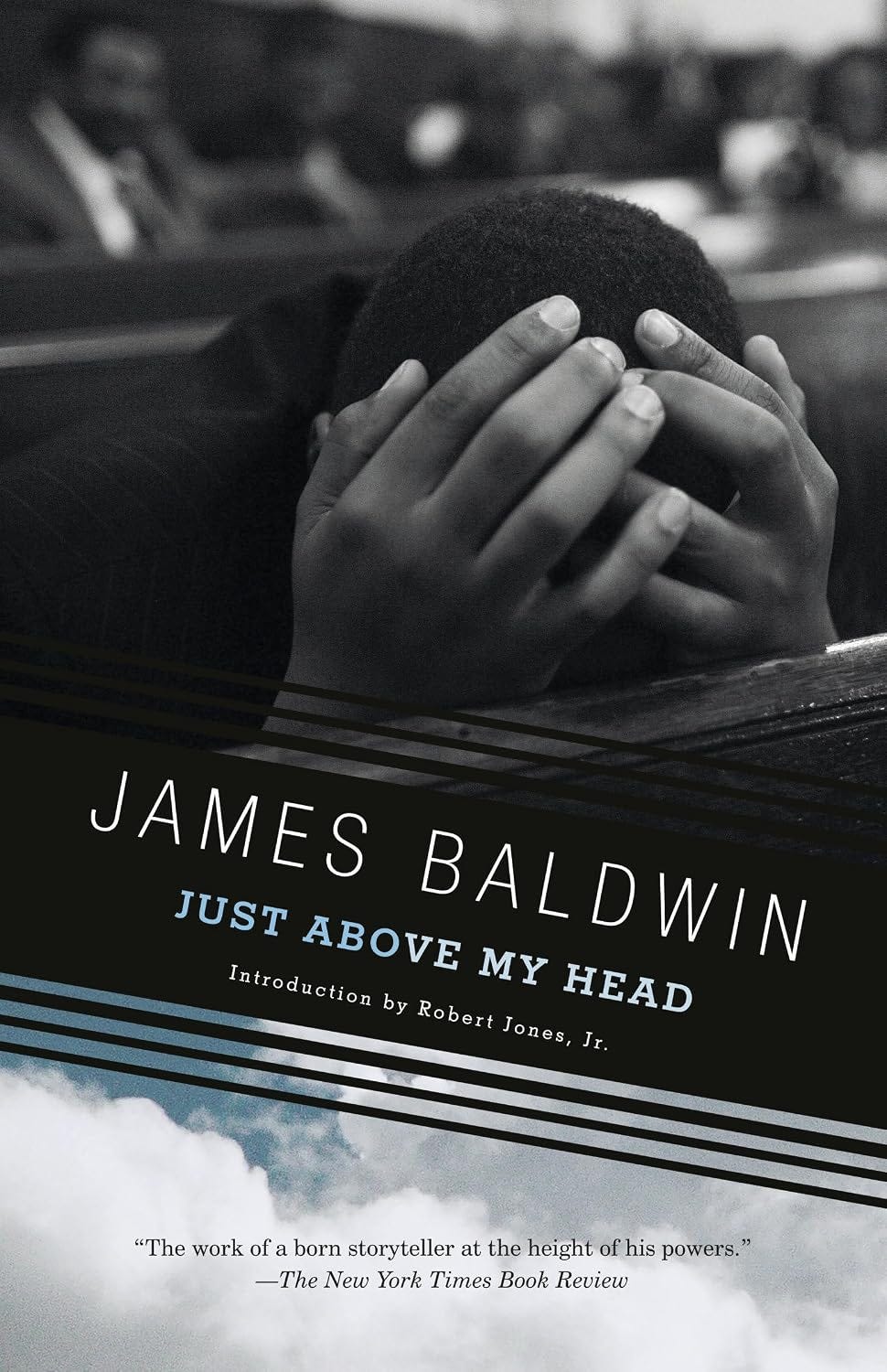
This is the novel’s description:
Arthur Montana, celebrated gospel singer, has been found collapsed in a London pub at the age of thirty-nine. His brother, Hall, is left to write the story of his life, his talent, and his great love. Retracing the past three decades of their history, Hall writes with tender passion about the central characters in Arthur’s life: Sister Julia, a “fire-baptized” child evangelist called to the ministry when she was nine, whose life seems considerably less “redeemed” out of the pulpit; and Julia’s brother Jimmy, Arthur’s most gifted accompanist, the catalyst of his success as a singer, and his devoted lover.
An unforgettable epic drama spanning the distance from the Apollo in Harlem to the Olympia in Paris, Just Above My Head is a magnificent tale of personal courage, commitment, and profound love filled with all the lyricism, violence, and compassion that comprise the human condition.
Here is what critics had to say about Just Above My Head upon its release:
“Some of the finest scenes in recent American literature. Baldwin expands the territory of the black novel.”
— The Village Voice
“The work of a born storyteller at the height of his powers . . . glimpses of family life in Harlem, rapturous music-making in the churches, moments of uneasiness in even the most casual meetings between whites and blacks—scenes that Baldwin seems preternaturally gifted in understanding.”
— The New York Times Book Review
“Baldwin is at his earthy best. Deliberately shocking and writing as brilliantly as ever about ‘how it was and how it is.’”
— The Kansas City Star
“A fine novel . . . it seems impossible for [Baldwin] to write with anything other than eloquence. His great and peculiar power is to re-create the maddening halfway house that the black man finds himself in late-twentieth-century America.” — The New Yorker
And here is an excerpt from Just Above My Head:
THE DAMN’D BLOOD BURST, first through his nostrils, then pounded through the veins in his neck, the scarlet torrent exploded through his mouth, it reached his eyes and blinded him, and brought Arthur down, down, down, down, down.
The telephone call did not go into these details, neither did the telegram: urgently demanding my arrival because my brother was dead. The laconic British press merely noted that a “nearly forgotten Negro moaner and groaner” (this is how the British press described my brother) had been found dead in a men’s room in the basement of a London pub. No one told me how he died. The American press noted the passing of an “emotion-filled” gospel singer, dead at the untidy age of thirty-nine.
He had been losing his hair, that rain forest of Senegalese hair, I knew that. Jimmy had not been with him; Jimmy had been waiting for him in Paris, to bring him home. Julia had been clearing up their rooms in her house in Yonkers.
I: sat by the telephone. I looked at the marvel of human effort, the telephone. The telephone beside my bed was black—like me, I think I thought, God knows why I thought it, if I did. The telephone in the bathroom was gray. The telephone in the kitchen was blue, light blue.
The sun was shining that morning, like I’ve never known the sun to shine before.
He had been found lying in a pool of blood—why does one say a pool?—a storm, a violence, a miracle of blood: his blood, my brother’s blood, my brother’s blood, my brother’s blood! My blood, my brother’s blood, my blood, Arthur’s blood, soaking into the sawdust of some grimy men’s room in the filthy basement of some filthy London pub.
Oh. No. Arthur. I think I laughed. I think I couldn’t cry. My brother.
The house was empty. Ruth was out shopping, Tony and Odessa were at school: it was a Thursday morning.
My brother. Do you know, friend, how a brother loves his brother, how mighty, how unanswerable it is to be confronted with the truth beneath that simple word? Simple. Word. Yes. No. Everything becomes unanswerable, unreadable, in the face of an event yet more unimaginable than one’s own death. It is one’s death, occurring far beyond the confines of one’s imagination. Or, surely, far beyond the confines of my imagination. And do you know, do you know, how much my brother loved me? how much he loved me! And do you know I did not know it? did not dare to know it: do you know? No. No. No.
I looked and looked and looked at the telephone: I looked at the telephone and I looked at the telephone. The telephone was silent. This was the black telephone. I stumbled to the gray telephone, in the bathroom. Perhaps I thought that it might have mercy on me if I humbled myself on the toilet. Nothing came out of me, not even water, and the phone did not ring. I walked to the light-blue telephone in the kitchen, and looked at it and looked at it: it looked at me, from somewhere over the light-blue rainbow, and it did not ring, it did not ring, it did not ring! It did not ring. How can you do this to me, how can you tell me what you have just told me, and now, sit there like that, over the motherfucking goddamn rainbow! and hold your peace? Oh. If you were a man, like me. Oh. Oh. Oh. Arthur. Speak. Speak. Speak. I know, I know. I wasn’t always nice to you, I yelled when I shouldn’t have yelled, I was often absent when I should have been present, I know, I know; and sometimes you bored the shit out of me, and I heard your stories too often, and I knew all your fucking little ways, man, and how you jived the people--but that’s not really true, you didn’t really jive the people, you sang, you sang, and if there was any jiving done, the people jived you, my brother, because they didn’t know that they were the song and the price of the song and the glory of the song: you sang. Oh, my God my God my God my God my God, oh my God my God my God oh no no no, my God my God my God my God, forsake me if you will and I don’t give a shit but give me back my brother, my God my God my God my God my God!
I did not cry. Nothing came out of me, not even water. I stood, as dumb and naked as a horse, under the shower. I dried myself, and I shaved—very very slowly, very very carefully: I was shaving someone else. I looked into my eyes: they were someone else’s eyes. I combed my hair. The phone did not ring. Soon I would have to pick it up and dial a number and get on a plane. London Bridge is falling down. My fair lady.
Ruth found me naked, flat on my back, on the bathroom floor, my razor in my hand: and the phone was ringing.
Two years ago: if Arthur were alive now, he would be approaching forty-one. I am the older brother, and I will be forty-eight this year.
My name is Hall: Hall Montana. I was born in California, but Arthur was born in New York and we grew up in New York.
Our father, Paul, died several years back—died, I think, from having crossed a continent to find himself in New York. He had been born in Tallahassee, grew up in New Orleans, and had had a rough, rough time in California. He died, anyway, while Arthur was still Arthur, thank God; he split the scene before Arthur started down. Florence, our mother, once Arthur was in the ground, went back to New Orleans—where she and Paul had met—and she’s staying there now, with one of her younger sisters. Ruth, and myself, and the kids try to make it down there for a couple of weeks every summer, and sometimes I bring Mama up here, for Christmas. But she doesn’t like it up here. Maybe she never did—but now, when she visits, I can feel her flinching. She doesn’t say anything, the pain is at the very bottom of her eyes. I catch it sometimes, when she’s just sitting still, looking at television or looking out of the window, or sometimes, when she’s walking along the street. She doesn’t like to go to church up here. She says that the people don’t have any spirit, that their religion ain’t nothing but noise and show: they’ve lost the true religion. That may be true. I don’t go to church myself. But even if what she says is true, and I remember, too, how these people treated Arthur when he branched out from gospel, that’s not the reason. Any church up here might have Jesus on the main line all day and all night long, and Mama would never so lower herself as to go anywhere near that phone. No, never. She doesn’t like this city because it robbed her of her son, and she feels that the people in the church, when they turned against him, became directly responsible for his death. She goes to church down home, though, where she can grieve and pray, away from all the spiteful people whose tongues so lacerated her boy. She can sing to herself, without fear of being mocked, and find strength and solace in the song that says, They didn’t know who you were. And she’s not singing about Jesus, then, she’s singing about her son. Maybe all gospel songs begin out of blasphemy and presumption--what the church would call blasphemy and presumption: out of entering God’s suffering and challenging God Almighty to have or to give or to withhold mercy. There will be two of us at the mercy seat: my Lord, and I!
Two years ago: and I have never really talked about it: not to Ruth, not to my children, Tony and Odessa (who love their uncle), not to Julia, not to Jimmy: and they can’t talk about it until I can talk.
I know I’m wrong to trap them in my silence. Maybe it’s partly because I was Arthur’s manager. I had to talk about him for years, living, and then, dead, as a property, as a star: I had to protect him because Lord have mercy that nappy-headed mother did not know how to protect himself. That made me afraid that I’d lose him as my brother: that he would think that I also thought of him as the can of beans anybody could buy and which everybody sold--and down the river, baby, at a mighty handsome profit.
I don’t think that he thought of me that way. I know he didn’t. If he had, he would have died much sooner. I know it because I know that he never tried to hide anything from me, though sometimes, he tried to protect me, too. I know I loved him, and he knew it; with all my heart, I loved him; even when he made me so mad sometimes that I felt like I wanted to beat his brains out. He made his life so hard! Well. That’s not true, either. He lived the life he lived, like anybody, I guess, and he paid his dues, like everybody. Maybe what I mean when I say he made his life so hard was that he always tried to pay his dues in front. That isn’t always possible: it can even be called a bad habit. Maybe some dues are paid. Some dues may be just a bad memory; but you can’t really take that for granted unless you can trust your memory. The truth, anyway, is that I wouldn’t really give a shit about all these abstract speculations if I weren’t trying to talk about my brother. He was on stage. He caught the light, and so I saw him: more clearly than I will ever see myself.
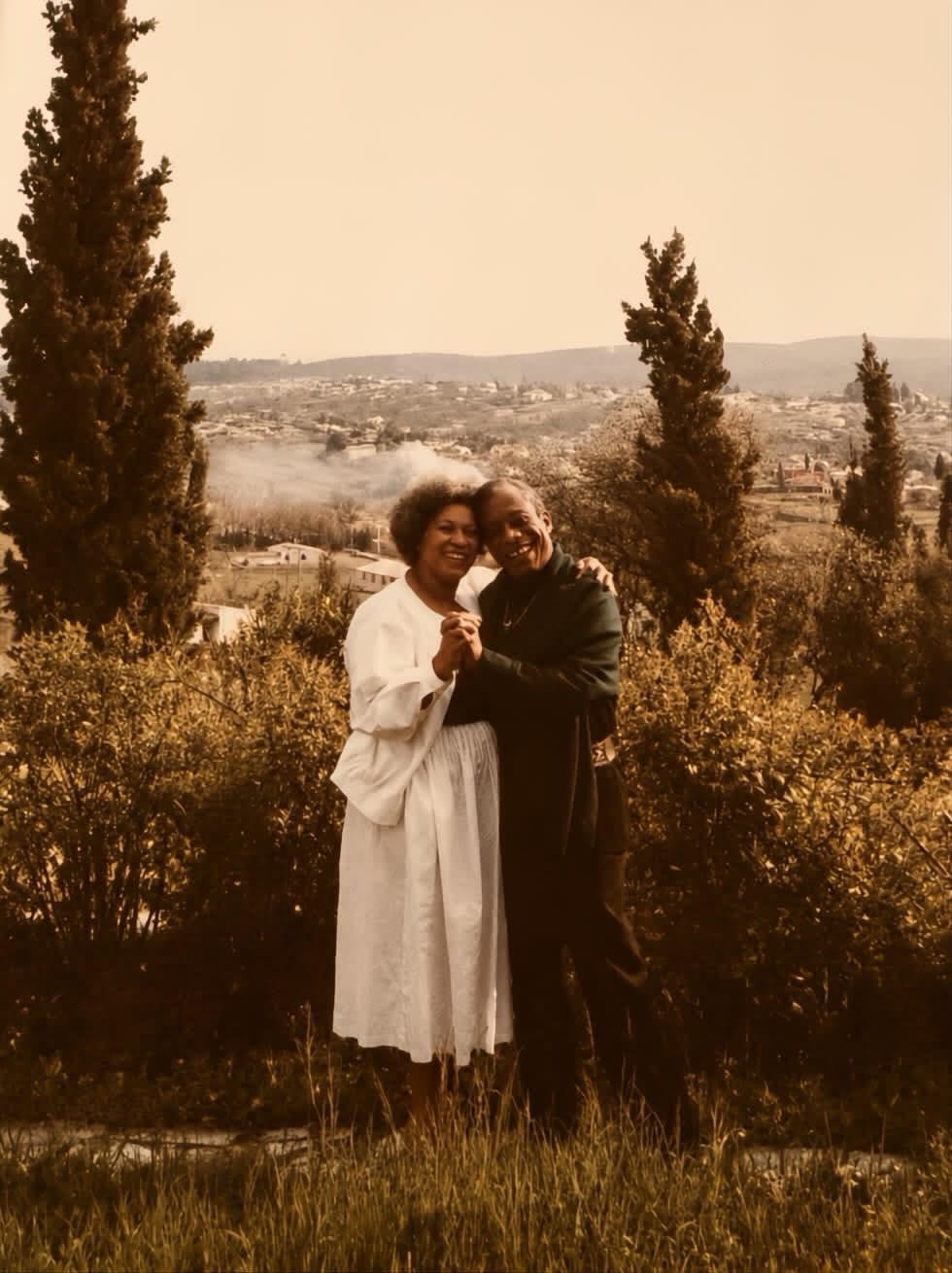
Here are some things people have had to say about Baldwin over the years in regard his impact, his work, and his legacy:
“There is no writer I return to more.”
— Ta-Nehisi Coates
“James Baldwin gave us permission to tell the truth.”
— Essex Hemphill
“If Van Gogh was our nineteenth century artist-saint, James Baldwin is our twentieth century one.”
—Michael Ondaatje, author of the Booker Prize-winning novel, The English Patient
“I knew that he knew black women may find lovers on street corners or even in church pews, but brothers are hard to come by and are as necessary as air and as precious as love. James Baldwin knew that black women in this desolate world, black women in this cruel time which has no soundness in it, have a crying need for brothers. He knew that brother’s love redeems a sister’s pain. His love opened the unusual door for me and I am blessed that James Baldwin was my brother.”
— Maya Angelou, “A Brother’s Love: Maya Angelou on James Baldwin,” Eulogy at James Baldwin’s Funeral, Cathedral of St. John the Divine, New York, New York, December 20, 1987
“Between Jimmy’s smile and grace, his insistent elegance even as he damned you, even as he smote what evil was unfortunate, breathing or otherwise, to stumble his way. He was all the way live, all the way conscious, turned all the way up, receiving and broadcasting, sometime so hard, what needed to, would back up from those two television tubes poking out of his head! He was our consummate complete man of letters, not as an unliving artifact, but as a black man we could touch and relate to even there in that space filled with black fire at the base and circumference of our souls. And what was supremely ironic is that for all his estheticism and ultra-so-phistication, there he was now demanding that we get in the world completely, that we comprehend the ultimate intelligence of our enforced commitment to finally bring humanity to the world! Jimmy’s voice, as much as Dr. King’s or Malcolm X’s, helped shepherd and guide us toward black liberation.”
— Amiri Baraka, “James Baldwin: His Voice Remembered; We Carry Him as Us,” Eulogy at James Baldwin’s Funeral, Cathedral of St. John the Divine, New York, New York, December 20, 1987
“Jimmy, there is too much to think about you, and too much to feel. The difficulty is your life refuses summation—it always did—and invites contemplation instead. Like many of us left here, I thought I knew you. Now I discover that in your company it is myself I know. That is the astonishing gift of your art and your friendship: You gave us ourselves to think about, to cherish. We are like Hall Montana watching ‘with new wonder’ his brother saints, knowing the song he sang is us, ‘He is us.’ Even now, even here, I need you to tell me what I am feeling and how to articulate it. So I have pored again through the 6,895 pages of your published work to acknowledge the debt and thank you for the credit. No one possessed or inhabited language for me the way you did. You made American English honest; genuinely international. You exposed its secrets and reshaped it until it was truly modern dialogic, representative, humane. You stripped it of ease and false comfort and fake innocence and evasion and hypocrisy. And in place of deviousness was clarity. In place of soft plump lies was a lean, targeted power. In place of intellectual disingenuousness and what you called ‘exasperating egocentricity,’ you gave us undecorated truth. You replaced lumbering platitudes with an upright elegance. You went into that forbidden territory and decolonized it, ‘robbed it of the jewel of its naivete,’ and un-gated it for black people so that in your wake we could enter it, occupy it, restructure it in order to accommodate our complicated passion—not our vanities but our intricate, difficult, demanding beauty, our tragic, insistent knowledge, our lived reality, our sleek classical imagination—all the while refusing ‘to be defined by a language that has never been able to recognize [ us ].’ In your hands language was handsome again. In your hands we saw how it was meant to be: neither bloodless nor bloody, and yet alive.”
— Toni Morrison, “For James Baldwin: ‘Jimmy. You crowned us,’” Eulogy at James Baldwin’s Funeral, Cathedral of St. John the Divine, New York, New York, December 20, 1987
“There is no greater witness to the American democratic experiment than James Baldwin.”
— Dr. Cornell West
James Baldwin was a giant among us; and he was, I think, often misunderstood and underappreciated while he was alive. Many people don’t realize that he never went to college; his intellectual curiosity and prowess were innate. He never won any of the major literary awards or prizes, but he was a recipient of a Guggenheim Fellowship and a MacDowell Fellowship. MacDowell, in fact, named its library in his honor. Despite the fact that we measure talent via accolades, Baldwin was the greatest writer of his generation, certainly the most influential. And we remember and return to him more than we do the writers who were rewarded above and beyond him. I think that’s more of a measure of his talents than anything else.
Film review. From Writer and Director Yashaddai Owens - Jimmy. Opened on Friday, July 31, 2026 in New York City at IFC Center. Los Angeles and other cities to follow. “It’s 1948 in Harlem, New York and a young James Baldwin is seeking something more than his stateside life. Weaving this starting point into a modern narrative, Jimmy charts Baldwin’s arrival abroad through energetic and sweeping handheld camera work in Yashaddai Owens’ debut feature film. From the rich landscapes of Istanbul and onto the streets of Paris, we follow Jimmy in his early experiences of life abroad, blurring our consciousness of time and place to uncover the truth of how an artist navigates their way in the world. Starring: Benny O. Arthur.
I’ve concluded that governments and institutions—United States’ governments and institutions in particular—were terrified of Baldwin, particularly in his later years when they called him bitter because he became less conciliatory and more pointed, and accurate, in his understanding and assessment of, and confrontation with, the danger and wretchedness posed by people who think of themselves as white. Ain’t no such thing as halfway crooks: Can you imagine that this bisexual as fuck, 5’5” Black man with a big brain, all-seeing eyes, and a Mid-Atlantic tongue had all these peckerwoods shook? Unlike Medgar Evers, Malcolm X, and Martin Luther King, Jr., all of whom were friends of his, the state didn’t assassinate Baldwin—at least not in one fell swoop. Instead, they sought to achieve it in increments: They worried him to death; haunted and hounded him so bad that he had to pick another empire to live in. This isn’t speculation: He had the longest FBI file of any Black artist of the civil rights era.
ABC attempted to bury this interview with James Baldwin, which came out right after the release of his last novel, Just Above My Head. When television and film producer Joseph Lovett asked why ABC never aired the interview, he was told in essence that no one wanted to listen to “a Black gay has-been.”
Though he’s no longer with us in body, his soul has left a lasting impression on the world. I imagine we will be wrestling with his art, and his hopes and expectations for humankind, for centuries to come (if there are any centuries to come, and we haven’t blown ourselves to smithereens). I don’t mean to cast Baldwin as perfect; he wasn’t. But neither are any of the figures we revere. And neither are we. All glass cracks—including mirrors.
Unlike many others, however, I don’t think Baldwin would expect us to consider or place him above reproach. I think he would frown at the modern to think of him as outside the confines of accountability. I think he would want us to learn as much from his mistakes as we do from his triumphs.
Happy birthday, Baba Baldwin!
We love you.
We speak your name.
The First Vintage International Edition of Just Above My Head (with a striking new cover) will be available in stores on September 26, 2026, but you can pre-order it now at your favorite local bookstores.
Pre-Order: HERE.
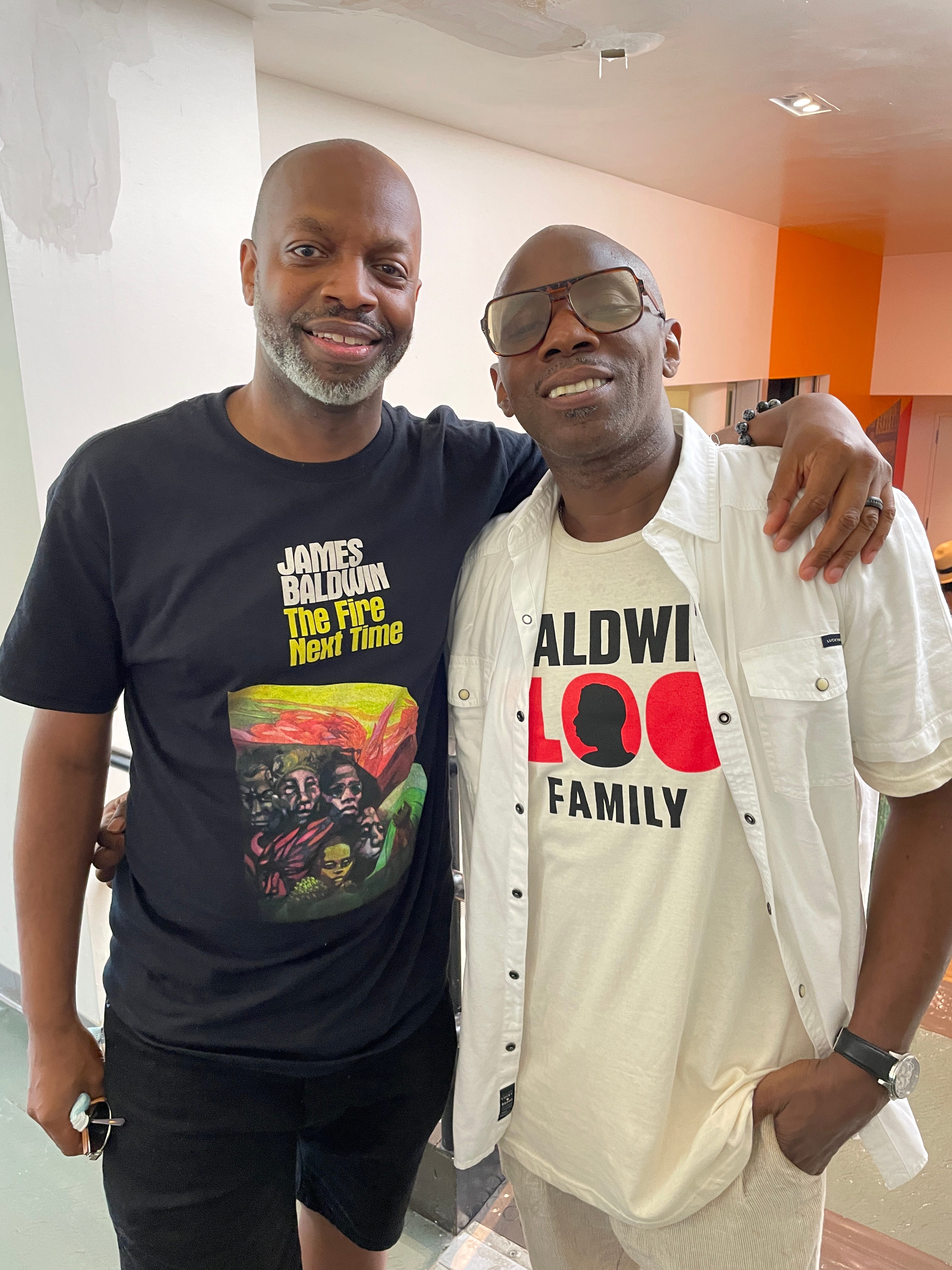


The James Baldwin Lawn in St. Nicholas Park, located at West 135th Street and St. Nicholas Avenue in Harlem, New York.